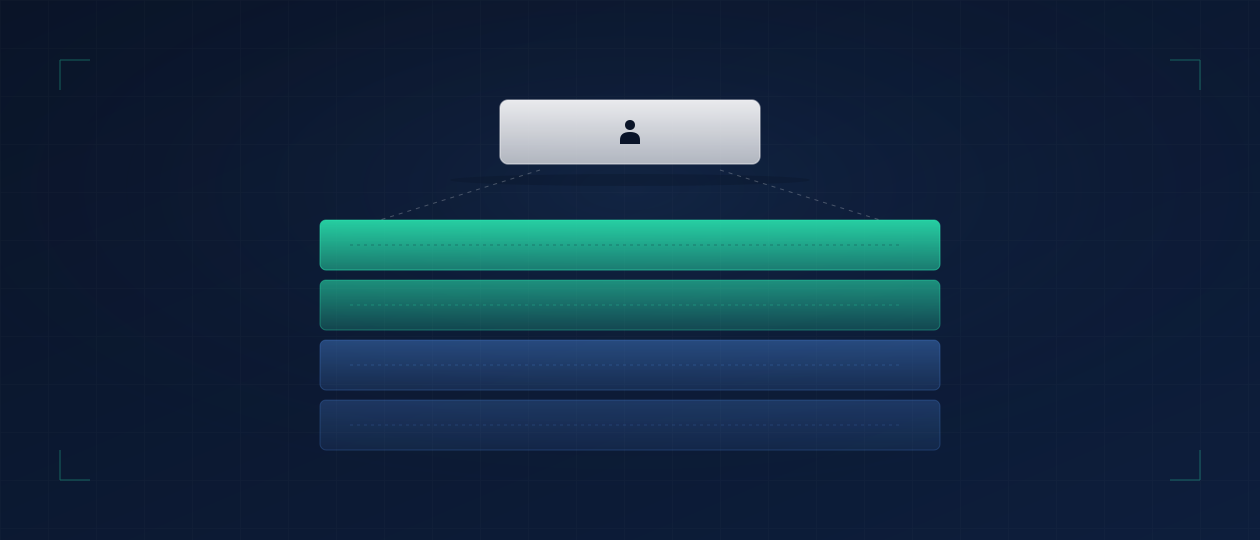
When a prospect calls a service business and gets voicemail, two things happen at once. The first is obvious: that lead might not convert. The second is invisible and far more expensive: the cost of acquiring that lead just got transferred to the next ten leads, because your effective conversion rate dropped and your blended cost-per-customer went up.
Almost no operator runs that math. We spend a lot of time helping clients run it.
The numbers we see, audited across a portfolio of service businesses we work with, look roughly like this. Inbound calls miss the live-answer window 35 to 50 percent of the time, depending on industry and time of day. Of those missed calls, fewer than one in ten get a callback within sixty minutes. Of the callbacks that happen later, conversion rates collapse: a lead called back within five minutes converts roughly five times higher than the same lead called back four hours later.
The compounding effect is what really hurts. Each missed lead is not a one-time loss. It is a cascade.
The cascade nobody traces
Walk through what happens when one inbound call goes to voicemail at 2:14 PM on a Tuesday in a residential service business.
2:14 PM, Caller leaves a voicemail. Or hangs up. Statistically, hanging up is more common.
2:18 PM, That same caller dials your nearest competitor.
2:22 PM, Competitor answers, books a same-day estimate, sends an SMS confirmation.
2:45 PM, Your team finishes the job they were on, sees the missed-call notification on their phone, decides to call back later.
4:30 PM, Operator wraps the day, checks voicemails, tries to call back. The caller is now on the road, does not answer.
Day 2, A second callback attempt goes to voicemail. The caller's competitor is now in their driveway.
Day 3, Caller leaves a five-star review for the competitor that answered within four minutes.
The lost revenue from the original missed call is the smallest part. The competitor's review just made their next paid ad ten percent more efficient than yours. Your ad costs went up. Your conversion rate went down. Compound that across a hundred missed calls in a quarter, which is normal for a $2M service business, and the gap between you and the operator next door becomes structural.
Three archetypes of missed-call leakage
The fix depends on which type of leakage you have. We see three patterns across the service businesses we audit:
The "we are slammed" miss
Symptom: peak hours generate the most leads and also the most misses. Tuesdays at 11 AM, Saturdays before 10 AM, the first warm week of spring. The team is working, not picking up.
Cause: human bandwidth is finite. Live answer is impossible during the busiest hours unless you over-staff for the worst-case load, which kills margin.
Fix: an automated SMS that fires within 90 seconds of the missed call, structured to qualify the lead and book a callback slot. Done correctly, this recovers 60 to 70 percent of the missed calls without adding headcount.
The "we are closed" miss
Symptom: 25 to 40 percent of inbound calls land outside business hours. Most operators only count weekday-business-hour misses, so this leakage is invisible until you instrument it.
Cause: the prospect's research and decision-making cycle does not match the team's working hours. Dishwashers fail at 9 PM. Roofs leak on Saturday mornings.
Fix: an after-hours auto-response that acknowledges the call, sets clear expectations on response time, and offers a same-day or next-business-day callback slot via a self-service link. Most service businesses can recover another 30 to 50 percent of after-hours misses with a credible auto-response, because the prospect's alternative was to keep calling other operators until someone answered.
The "no system" miss
Symptom: every miss is a miss. No tracking, no auto-response, no callback SLA, no follow-up cadence after the first attempt. The team is good when they answer and silent when they do not.
Cause: nobody has explicitly owned response time as a metric. The phone gets answered when convenient.
Fix: an actual response-time SLA written into the operations playbook, paired with an automated system that triggers fallback messaging and assigns ownership for the callback. This is the highest-leverage fix in the category because it converts an invisible failure mode into a measured one. You cannot improve what you do not measure.
A missed call is not a missed sale. It is the start of a cascade that makes every future ad less efficient and every competitor more credible.
What "good" actually looks like
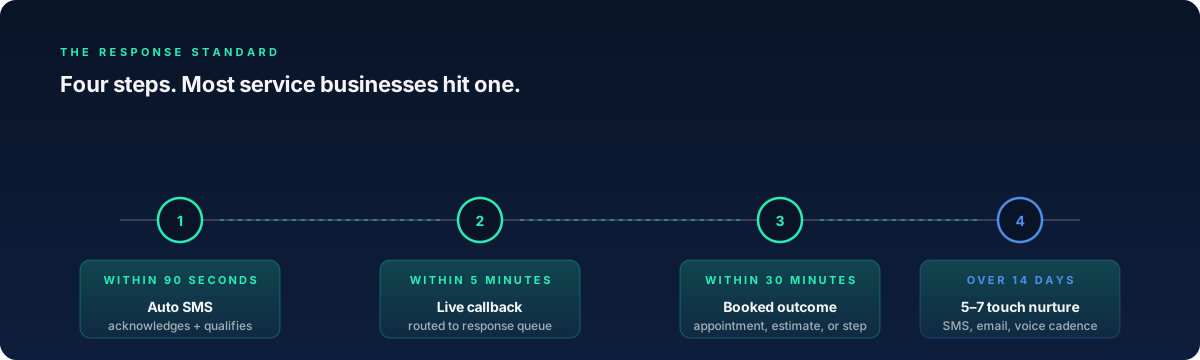
We benchmark every client we onboard against the same four-step response standard. It is the bar we believe a $1M+ service business should hit, and the bar most operators sit well below until somebody installs the system.
- SMS within 90 seconds of the missed call. Acknowledges the call, identifies your business by name, and offers an immediate next step (book a slot, request a callback, ask a clarifying question). This step alone recovers more revenue than any other single change we make in the first 30 days of an engagement.
- Live callback attempt within 5 minutes during business hours. Routed to whoever is on the response rotation, not whoever happens to be free. The five-minute number is not arbitrary. Research that has held up across dozens of replications shows lead-to-conversion drops by an order of magnitude beyond the five-minute mark.
- Booked outcome within 30 minutes. Either a confirmed appointment, a sent estimate, or a clear next step with a date. "I will call you back later this week" does not count as a booked outcome.
- Persistent follow-up cadence over the next 14 days for any lead that did not book on first contact. Five to seven touches across SMS, email, and voice, spaced to feel attentive rather than pushy. The data is unambiguous: the second through fifth touches generate more revenue than the first one in nearly every category we have measured.
That is it. Four steps, achievable inside a week of focused implementation, and most service businesses we audit are hitting maybe one of them.
Why this is hard to fix from the inside
If installing a four-step response standard were easy, every service business would already have one. The blocker is rarely awareness. Most operators we talk to know they have a missed-call problem. The blocker is that the fix requires writing workflows, configuring SMS providers, integrating with the calendar, building qualification logic, and then operating the system every week so it stays accurate. The team that is already too busy to answer the phone is also too busy to build and maintain the system that would help them answer the phone.
This is the gap our installed Growth Operating System fills. We do not sell software. We install and operate the response system, the workflows, the SLAs, and the weekly review cadence. The first 30 days of every DECO engagement are oriented around closing the response-time gap, because it is the single highest-leverage change available to most service businesses we work with.
If you want the longer view on why the operational ceiling matters more than headcount, the next post in this series is on why hiring another salesperson does not fix a revenue plateau. And if you are evaluating platforms right now, our comparison of GHL vs HubSpot vs ServiceTitan vs Jobber walks through which tool actually fits which stage.
Keep reading

Comparisons
GHL vs HubSpot vs ServiceTitan vs Jobber: which fits a $1–5M service business
7 min readThe DECO Team