

A revenue plateau in a service business almost always triggers the same reflex. Numbers stalled for two quarters, the founder stops being able to outwork the gap, and the natural next move feels like hiring another salesperson. Sometimes a closer. Sometimes a "BDR." Sometimes just "another me." The logic is intuitive: more capacity at the top of the funnel should mean more revenue at the bottom.
It almost never does.
Industry surveys and the data we see across our client portfolio point to a consistent pattern. Roughly seven out of ten new sales hires at $1–5M service businesses miss their year-one quota. Average ramp time from offer letter to consistent quota attainment runs seven to nine months, which is longer than the average tenure of a sales hire who fails out. The financial loss per failed hire, factoring in fully loaded comp, lost pipeline, and management time, sits in the $80K to $150K range for the businesses we have audited.
The instinct is to blame the hire. The data does not support it. The hire is mostly a casualty of an operational ceiling that was already there.
The five reasons sales hires fail in service businesses
We have unwound failed sales hires for enough clients that the pattern is now predictable. There are five reasons it happens, and they all live underneath the hire, not inside the hire.
1. The lead flow is the actual problem
A new sales rep does not generate leads. They convert leads. If the business hired the rep because revenue plateaued, but the lead volume plateaued first and nobody acknowledged it, the rep walked into a job that was structurally impossible from day one.
We see this in audits constantly. Inbound lead volume is flat or declining for two quarters. Founder attributes the plateau to "not enough closing capacity" because the founder is the one currently closing and feels stretched. New rep gets hired. Rep gets the same flat lead pool the founder was already converting at maximum rate. Rep underperforms because there is nothing left to convert. Rep gets blamed.
The fix to a flat-lead-volume plateau is never another seat in the closing chair. It is fixing the lead flow.
2. There is no sales operations to onboard a new rep
In B2B SaaS, the average sales rep walks into a job where the playbook, scripts, ICP profile, qualification framework, CRM workflows, demo environment, comp plan, and pipeline review cadence already exist. They were built by the previous five reps and the dedicated sales-ops team.
In a $1–5M service business, none of that exists. The founder is the only person who has ever sold the service. The "playbook" is in the founder's head. The "qualification framework" is the founder's gut. The CRM is half-populated. There is no demo environment because there is no demo. The new rep is supposed to figure all of it out from sitting in on a few calls and then go produce.
Most cannot. The ones who can are exceptional, command exceptional comp, and rarely take service-business jobs in the first place.
3. The comp plan is wrong for the work
Sales comp plans in service businesses are usually copied from product companies that pay 8 to 15 percent of first-year revenue as commission. That math works when the deal is $50K and the gross margin is 80 percent. It does not work when the deal is $4,500 and the gross margin is 35 percent. The rep who hits the same dollar target works five to ten times harder, the unit economics get squeezed, and the rep burns out or leaves for a SaaS job at twice the comp.
Comp plans for service businesses need to compensate for the longer cycle, the smaller deal, and the operational complexity downstream of close. We have seen comp plans that pay on customer lifetime value rather than first-deal revenue work much better, but they require the operational maturity to actually measure LTV reliably, which most $1–5M businesses lack.
4. The handoff between sales, dispatch, and delivery breaks under volume
This is the failure mode we see most frequently and discuss the least. A founder selling alone holds the whole transaction in their head. They quote, they confirm with dispatch, they oversee delivery, they collect payment, they handle the follow-up. Information does not get lost because one person owns it end to end.
Add a salesperson into that flow and the seams start to show. Sales books a job, dispatch does not get the right info, the technician shows up unprepared, the customer escalates, the founder ends up cleaning it up. Three episodes of that and the founder concludes the rep "cannot sell," when what is actually happening is that the operational handoff has no defined process, no system of record, and no cadence for catching errors.
The rep who would succeed in an environment with a real handoff process fails in one without it. And there is no way to know which kind of rep you hired until they are in the job.
5. The founder cannot actually let go of the relationship
The least technical of the five reasons and the most determinative. Most founders of $1–5M service businesses built their book of business on personal trust. Customers chose them because they were the founder. Letting another person own a customer conversation feels like risking the trust that built the business.
So the founder hires a rep, then re-injects themselves into every important call. The rep gets neutered. Customers feel handed off and then handed back. The rep concludes they are not actually being given the job. The founder concludes the rep cannot do it. Both are right inside their own frame.
The new sales hire is rarely the problem. The new sales hire is usually the diagnostic that surfaces the problem that was already there.
What works instead
The reframe is straightforward, but it requires sitting with it for a minute. Most $1–5M service businesses do not need another salesperson. They need an operational stack that turns the existing lead flow into more closed revenue without adding bodies.
The stack has four layers, in order:
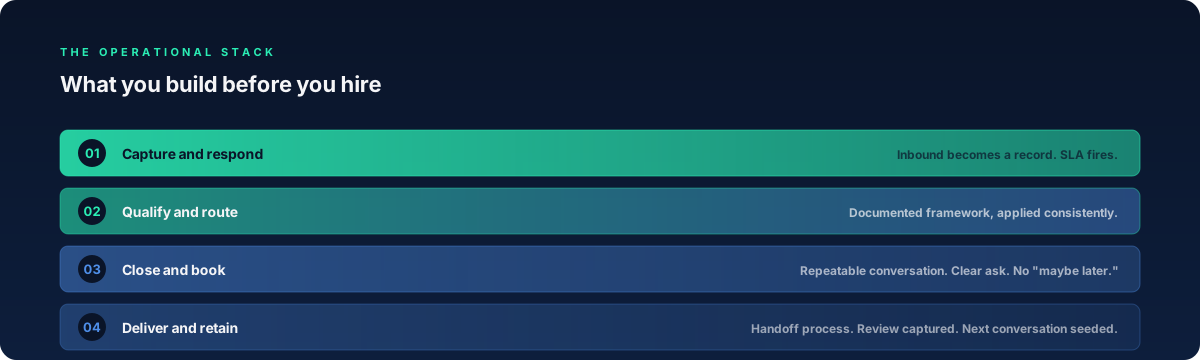
- Capture and respond. Every inbound lead becomes a structured record within seconds, gets an automated acknowledgement, and enters a measured response queue with an SLA. The leakage we documented in our post on missed-call follow-up is the most common failure point at this layer.
- Qualify and route. A documented qualification framework, applied consistently, separates good-fit prospects from time-wasters before a human spends 30 minutes on a call. This is the part that exists in the founder's head and almost never on paper.
- Close and book. A repeatable sales conversation with a clear ask. Booked appointment, signed estimate, or scheduled follow-up. No "I will think about it" left as the closing state.
- Deliver and retain. A handoff process that gets the job done well, captures the review, and feeds the next conversation cleanly.
When this stack is in place, a single great rep on the existing lead flow will outperform three average reps without it. We have watched this play out across enough clients now that it has become a guarantee in the discovery conversation: install the stack first, then evaluate whether you need the headcount. Most of the time, the headcount question answers itself.
When to actually hire
There is a real moment when the right move is to hire a salesperson. It looks like this:
- Lead volume has been growing for two consecutive quarters.
- The response and qualification stack is in place and operating reliably.
- The founder is already at the ceiling of how many qualified conversations they can close in a week, with the existing system running well.
- A documented sales playbook exists, derived from the founder's actual closing approach.
- A comp plan tied to lifetime value, not first-deal revenue, is ready.
When all five of those are true, hiring is the right move. The new rep walks into a system that catches them rather than tests them. They convert at near-founder rates inside three months instead of failing out at month nine. The hire pays back.
When any of those five are missing, the hire is a $100K bet on the chance that the rep is exceptional enough to compensate for the gaps. Most are not.
If you are sitting with the plateau right now, our comparison of GHL vs HubSpot vs ServiceTitan vs Jobber is a good place to start if you suspect the platform layer is part of the issue. And the services page walks through what the four-layer operational stack looks like when DECO installs and operates it on your behalf.
Keep reading


Comparisons
GHL vs HubSpot vs ServiceTitan vs Jobber: which fits a $1–5M service business
7 min readThe DECO Team